I just bought and assembled an IKEA nightstand. Having left all my furniture behind in moving from a small house in California to a tiny apartment in Montana, I’m gradually acquiring only the most necessary furnishings, and IKEA suits me perfectly. I’m not buying solid pieces that I’ll be passing on to my grandchildren, I’m buying for price and current utility.
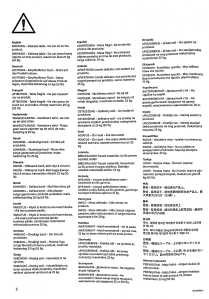
Whenever I start assembling IKEA furniture, it occurs to me that this may be the closest thing we have in the 21st century to a universal shared human experience. I count 32 languages on the page of warnings, and this doesn’t include the three additional languages on the following page (Malaysian, Arabic, and Thai — at least I think they’re Arabic and Thai; the print is so small I can barely make them out, and I’m not going to worry if I’m wrong). When I look at this page, in my mind I can hear people swearing at IKEA, all over the world, in all these languages.
And there are some notable omissions among the languages, too. I don’t know why Russian and Hebrew, at least, are not represented. Is there another set of instructions in 35 *other* languages for the rest of the world?
The other thought that IKEA brings to mind is the Wordless Workshop feature that appeared in Popular Science for over fifty years. Every month, the Wordless Workshop walked you through a household project in a series of drawings with absolutely no text.
I don’t know who, if anyone, had a subscription to Popular Science that made the issues accessible to me when I was a child, but I remember seeing it fairly regularly, and I remember being intrigued by Wordless Workshop. I had no occasion or opportunity to carry through any of the projects, so I think it was mostly a fascination with the problem-solving mindset, which was totally foreign to our household culture. My father was so unhandy, and so passive, that if a light bulb burned out he would have taken it as a sign from God that we were meant to sit in the dark. I’m sure it was partially in reaction to his apparent uselessness that after college, when I was in a position to learn to do things for myself, I took up photography, printing my own photographs in my closet-turned-darkroom, and taught myself how to tune the engine in my car (before computers made that equally unnecessary and impossible).
 Phil’s Blog