• An alarming email address

    It’s sometimes to fun to try to figure out what leads people to choose an email address.

    Every time I place an order with a company I’ve never used before, or sign up for a new online service, I use a new unique address that is automatically forwarded to my inbox so that if I’m spammed I can immediately tell who sold the spammer that address. Many of today’s email services recognize this problem and will allow you to create such a “masked” email address easily (Apple’s service is called “Hide My Email”).

    But most people don’t want their main email address to be obscure, and a commercial enterprise, in particular, needs an email address that reflects its identity.

    If you’re an individual with a common name using a “free” email service (like outlook.com or yahoo.com), you’re going to have trouble using your name as your email address, which is why there are so many addresses like johnsmith395688 out there.

    (Let me explain the use of the quotes around “free”. There’s a saying among privacy experts that if the product is free, then the product is you. Anytime you sign up for something that’s “free”, the provider is collecting information about you. If you want privacy, pay for it.)

    If you’re in business, to my mind there is no excuse for using a “free” service like outlook.com for your email. Paid email services are cheap for what they provide, and they make it easy to have a professional-looking address like “info@joescleaners.biz” (which, by the way, is really available right now if you want it).

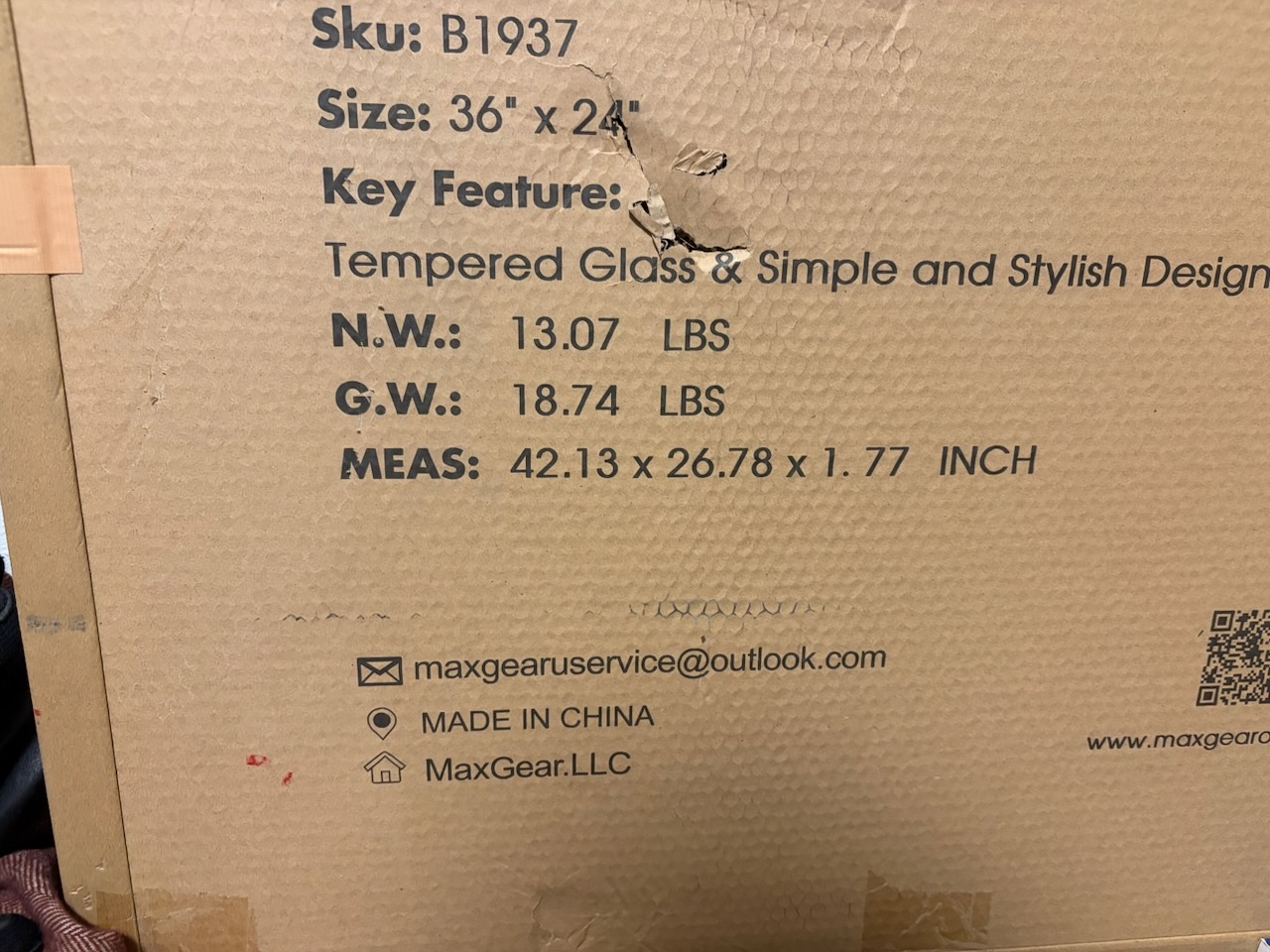
    Which brings us to today’s topic. Take a look at the the carton in the photo. This carton contained the whiteboard I just bought. Try to make sense of the email address on it. Try to *remember* the email address after looking away, and bear in mind that email addresses are completely unforgiving. Make an error in one character, and the email system responds to your message with “huh?”

    What the heck is “maxgearuservice”? Is it “maxgear user service” mashed together so hard that the two occurrences of “ser” got squished into one? Is it “maxgear us [i.e. “U.S.”] service” mashed together with the “ss” squished into “s”? Or is it what it most easily separates into, “max gear user vice”? Do they really have a department devoted to user vice?

    Interestingly, this email address doesn’t appear on the company’s website. The address you find on their “support” page is maxgear2022@gmail.com — another obscure address at another “free” service. (Why “2022”? The “about” page implies that they’ve been in business since 2010.) But maybe that’s the point. If you can’t remember or find their email address, or find it hard to type into the “To:” box, you’re less likely to ask them for the customer service they would probably prefer not to provide.

  • It’s my party, and I’ll cry if I want to

    I don’t mean to turn this entire blog into a pity party, so let’s get the whining out of the way. Then we can move on to happier, potentially more interesting topics.

    If you took the trouble to read a long way into the article on highly-gifted children that I posted last time (and I really didn’t expect that anyone would), you learned that seventeen of the sixty children in that study were appropriately challenged with accelerated programs. Those children throve. Five skipped two grades and did almost as well. Five skipped one grade; these five had notably less successful outcomes. And the thirty-three children who stayed in classrooms with their age peers felt isolated, had trouble making friends, and (in two cases) developed severe depression.

    I skipped one grade. To be more accurate, I spent one year in two grades. Get the picture: It’s September 1959. We are in Newport, Maine. I am ten years old; I will turn eleven in November. I am starting sixth grade. I attended fifth grade in this town and in this school, but this is already the third town I’ve lived in since I started school; there will be two more towns and three more schools before I finish high school.

    At some point during the school year (I don’t remember what time of year or what time of day), the principal comes into the classrom and tells me to gather my things. I am moving into seventh grade. So like a good little boy, I get my things and follow him. All of a sudden, I’m a seventh-grader.

    Yes, it was that abrupt — at least in my recollection. (I have a vague memory of an earlier meeting with school officials in which they told my parents they were planning this, and I must have been there, too, unless I’m just imagining it now.) I did literally walk out of a sixth-grade classroom into the seventh grade. I guess a normal kid would have been bewildered, and (at least somewhat) upset at being torn away from a familiar classroom and classmates. But I already had a strong sense that I wasn’t a normal kid, that adults were incomprehensible beings who exercised an arbitrary power over me, and that it was best just to play along.

    Before we moved to Newport in 1958, I had not had much sense of being different. I knew I was more interested in books and music, and less interested in playing sports, than most kids my age. But I don’t think I was far outside the normal range of kids. I played outdoors. I had friends. I visited them at their homes to play Monopoly and to play with their model railroads. I was a Red Sox fan. When we visited my mother’s parents (Grampy and Grammy) in Quincy MA in the summer, Grampy took me to Fenway Park and taught me how to keep a box score. I’m sure I saw Ted Williams play, though I don’t remember any specific games. I even collected baseball cards, for heaven’s sake.

    Life changed during the Newport years (1958-1961). Some of the reasons are obvious given my age at the time (think puberty). But I think something analogous to puberty was going on in my brain. I can only describe it by analogy. It seems, looking back, as if my mind was exploding in all directions. I haunted the public library. I couldn’t get enough books, or read fast enough, to explore all the avenues my curiosity was leading me down.

    And I had no one to share this with. I wasn’t making friends with kids my age, and I learned very quickly that adults don’t want to have a serious conversation with an eleven-year-old. But I had a rich inner life with my books and my music, and I can’t say that I felt unhappy, because I didn’t know there was any other way that life could be. It was later on, when I discovered that maybe it hadn’t had to be that way, that I became angry and depressed. But we’ll leave the story there for now.

    Over the last few years, since I started my self-analysis, I’ve discovered books and articles that have helped me understand myself and reassured me that I was not the only one. Here’s one of those articles. It’s short.

    https://youngholm.com/py/assets/kohlenberg_understanding_smart_people.pdf

    You would cry too, if it happened to you.

  • Bright boy; or, If you’re so smart, why ain’t you rich?

    Please glance, at least, at this document before reading this long post. It’s the reason I’m writing. I believe I would have been one of the children in this study, if I had been in the right place at the right time.

    https://youngholm.com/py/assets/gross_exceptionally_gifted_children.pdf

    I’ve always been introspective, but until a few years ago I had never examined my life systematically or in any detail. In March 2022, I decided to find out, if I could, why I had found my life so seemingly unsatisfactory. I started writing random autobiographical fragments at odd hours. This turned out to open floodgates of reminiscence, and I wrote over a hundred pages in the next two months.

    I also dragged out the flotsam that had been accompanying me through all my moves from place to place. I had tried to weed this during each move, but there were still several boxes’ worth of materials I had never been able to part with, going back to things my mother had saved from my childhood. I found dozens of new-baby welcome cards from my parents’ church friends (apparently this was a thing in the 1940s), report cards from elementary school, mementos, travel diaries, a virtually complete archive of my freshman year at college, and much else. What I did not find, however, were my transcripts from high school, college, and graduate school, so to complete the record, I ordered them all.

    It took several exchanges of email messages with Central Catholic High School to convince them that I really had graduated there (I wound up sending them a scan of the 1965 commencement program showing that I had been valedictorian). I finally got my transcript on April 1, 2022. An appropriate day, because when I examined it, I thought the universe was playing a joke on me. In a box labeled “IQ” were two entries. One entry said “158, California SF, 1/17/63”. The other said “160, Henmon Nelson – B, 11/63”. A little research showed that these were two standardized tests of mental ability from that era.

    “California SF” is plainly the California Short-Form Test of Mental Maturity. The date shows that I took the test when I transferred into the school in the middle of my sophomore year. “Henmon Nelson – B” must be Henmon-Nelson Tests of Mental Ability, Form B, in its revised edition of 1957. The date I took this test implies that it was being given to all new juniors, probably as part of preparing for college applications. I found favorable reviews of both tests in the psychological literature.

    I had always known I was smart. Other people sometimes treated me as though I was smart — which was not always a good thing in small-town America around 1960. I skipped a grade in elementary school, and my paternal grandfather constantly referred to me as “The Professor” (though that may just have been because I wore glasses from the age of eight or so). But no one ever told me the numerical result of any IQ tests, and aside from skipping a grade, I was never put on an accelerated track or offered advanced courses.

    I hasten to say that 158 and 160 are just numbers typed by a school secretary in the mid-1960s. They may be typographical errors. They don’t entitle me to claim that my IQ is any specific number. A truly reliable IQ, to the extent that you give credence to IQ numbers, can’t be determined by a standardized written test given to a roomful of people in a couple of hours, as these undoubtedly were (I don’t remember them). For a reliable indicator, you have to be tested one-on-one, in an all-day session, by a psychologist with a PhD, at a cost of thousands of dollars. This is particularly true in the range of high scores, since the most popular written tests at the time (Wechsler and Stanford-Binet) had a cut-off of 160, according to my research. I suspect, but don’t know, that the Henmon-Nelson had the same cut-off, which would mean that a score of 160 actually means “minimum of 160”. (If your car’s speedometer only reads up to 100, and you pin the needle, you have no way of knowing if you’re going 100, 120, or 140 — at least, not based on that speedometer.)

    Based on this and other evidence, though, I think it’s clear that I was one of the exceptionally gifted. The article I cite at the top of the post makes the point that gifted children don’t reach their potential — and, perhaps more importantly, lead happy, fulfilling lives — unless their gifts are appropriately recognized and nurtured. I’ve come to think that, although my life has been rewarding in many ways, it’s fallen far short of what it could have been.

  • Limpa

    I’ve done no baking, and hardly any cooking, since I moved to Missoula nine months ago. I eat cereal, sandwiches, salads (though not enough of them) and prepared meals that are delivered to my door. This is the way I planned things, since I wasn’t sure how much energy I’d have, and my apartment has no kitchen to speak of, just a refrigerator, a sink, and a small countertop.

    To compensate for the lack of cooking facilities in the units, my building has three spacious common rooms, each with a complete kitchen. (In fact, one of the common rooms has two complete kitchens in it.) So it’s not that I can’t cook or bake, I just need to do it in a communal kitchen.

    This reminds me of graduate school in Ann Arbor (1973-1974), when I lived in a monkish single room with a bed, a chair, and a dresser (I may have had a table too, but I don’t remember it). I ate in a co-op house, though I didn’t live there. At the co-op everyone had a job, of course, and my assignment was to be in charge of dinner once a week. I didn’t do the menu planning or the purchasing, but on Mondays (I think it was) I spent the entire afternoon in the kitchen preparing a meal for the thirty or so members of the co-op. For the last couple of hours I was joined by a couple of assistants, but it was my responsibility to make sure that the meal was on the table by the appointed time.

    This arrangement of boarding, but not living, at the co-op suited me perfectly, and I’ve often referred to it since as my ideal living situation. I was a full member of the co-op, so I could hang out there as much as I wanted. When I wanted company or to watch TV, I could walk a couple of blocks to the co-op. When I wanted quiet and privacy, I stayed in my room, where (even though I shared a bathroom with a couple of other people on my floor) I don’t think I ever interacted with any of the other residents.

    As Thanksgiving and Christmas approach, I’ve usually gotten a hankering to make Swedish rye bread. And — opportunely — a month ago or so, a new acquaintance at church talked me into signing up to co-host today’s coffee hour. That’s how I found myself baking for the first time since I left California.

    “Limpa” is the Swedish term for rye bread. We grew up calling it “vörtlimpa”, “vört” being the cognate of English “wort”, meaning the malt-infused liquid that is the basis of beer. Adding wort to the dough adds a particularly rich flavor, according to the experts. We didn’t know that when we were growing up, of course — there was no beer drinking in our family until later — and whether there was wort in the limpa we ate is anyone’s guess now. As far as I recollect, Grammy never made her own limpa, anyway — she bought it from the local Swedish bakery, Grahn’s (now sadly defunct — I checked).

    So I don’t have an old family recipe for limpa, I’m afraid. When I decided to try making it some years ago, I used James Beard’s recipe, since I already had his breadmaking book, “Beard on Bread” (clever title). The recipe is so good that I haven’t been tempted to try another. It doesn’t call for wort as such, but it does call for a pint of beer. (I usually go for a stout.)

    Baking in an unfamiliar kitchen is always a challenge, so I didn’t expect much from the first batch of limpa — and indeed it didn’t turn out very well. But it was edible. Even the next two batches, which I served at church, were disappointing to me. I was told that the oven in our common room ran low, so I tried to compensate, but the loaves were still underbaked. On the other hand, all the bread I put out at coffee hour disappeared, and two people actually came and sought me out in the church kitchen while I was making more coffee to say how much they liked it. All in all, it was closer to success than failure. I’m supposed to bring limpa to Thanksgiving dinner, so I’ll be continuing to work on it.

    For those who want to try it at home, here’s the recipe.

    James Beard Swedish Limpa

    Servings: 1 large free-form loaf or 2 small free-form loaves

    Ingredients:

    1 package active dry yeast

    1 tsp. sugar

    1/4 c. warm water (100 to 115 degrees, approximately)

    2 c. ale or beer, heated to lukewarm

    1/4 to 1/2 c. honey (to taste)

    2 tbsp. melted butter, plus extra for bowl, baking sheet and brushing

    2 tsp. salt

    1 tsp. ground cardamom (optional)

    1 tbsp. caraway seeds

    2 tbsp. chopped candied or freshly grated orange peel

    2 1/2 c. rye flour

    3 c. all-purpose flour

    Directions:

    In a large bowl, dissolve yeast and sugar in water and let proof for 5 minutes.

    In a medium bowl, whisk together ale (or beer), honey, butter and salt. Add beer mixture to yeast mixture and stir to combine. Add cardamom (optional), caraway seeds and orange peel and stir to combine.

    In a large bowl, whisk together rye flour and all-purpose flour. Add 3 cups of flour mixture to yeast mixture and beat very hard with a wooden spoon. Cover with a cloth or foil and let rise in a warm place for about 45 minutes to 1 hour.

    Stir down and add enough remaining flour to make a fairly stiff, although sticky dough.

    Turn dough out on a board, using 1/2 to 3/4 cup additional rye-all-purpose flour if needed to work the dough until smooth and elastic. Knead well, and while the dough will not lose its tackiness entirely, it will become smoother. Shape dough into a ball, place in a buttered bowl, and turn to coat dough with butter on all sides. Cover dough and let rise until doubled in bulk, about 45 minutes to 1 hour.

    Punch down, shape into 1 large bowl or 2 smaller balls and place on a greased baking sheet.

    Brush with butter, cover loosely with waxed paper or plastic wrap and refrigerate at least 2 hours and preferably 3 hours.

    Remove from the refrigerator and let sit, uncovered, at room temperature for 10 to 15 minutes. Preheat oven to 375 degrees. Bake bread until it sounds hollow when tapped on the bottom, about 75 to 80 minutes for a large loaf and 40 to 45 minutes for smaller loaves. Remove from oven and cool on racks before slicing.

  • That post about the elevator …

    … isn’t as silly as it first appears, I think.

    With today’s technology you could certainly build an elevator that’s called automatically when you stand in front of it. (I bet somebody has, probably in Japan.) Doors that open when you walk in front of them are commonplace nowadays. They’re annoying when they startle you as you walk past them on your way to somewhere else, but they’re a godsend when you’re leaving a store with an armload of packages — not to mention for people with mobility problems.

    Why do we not have easier ways to call an elevator?

  • I waited for hours…

    Oh — I have to press the button first? But you didn’t put that on the sign!

  • Who are you?

    Or, more specifically, who is the “you” I keep addressing in these posts? Who am I writing for? Why am I writing?

    Blogs are just new bottles for old wine. In a sense, people have been blogging for centuries, even millennia — they just didn’t have the web to pour their thoughts into. Marcus Aurelius’s Meditations, Pascal’s Pensées, and Montaigne’s Essays might all have been blogs if the technology had existed when they wrote.

    The great thing about blogging is that it’s what you want it to be. You can post any series of off-the-wall writings on the web and call it a blog. (The OED defines “blog” as “a frequently updated website … consisting of personal observations arranged in chronological order …”). It could be a log of what you had for breakfast every day, or it could be a record of your progress in coming up with the Grand Unified Theory of Everything.

    I enjoy writing, and (I know this is unusual) I enjoy rewriting. Like most white-collar workers, I’ve written a lot over the years as part of my job, usually in an attempt to explain something. (Think technical writing.) Occasionally, I flatter myself, I think a thought that others might find interesting. And over the past few years I’ve used writing as way to examine my life and make sense of it.

    As I approach the end of life, this is coming together here in the blog. I’m not the Ancient Mariner, and I’m not my father, buttonholing reluctant people in order to harangue them. If you want timeless insights, read Montaigne. But if you’re a family member or friend who wants to know me a little better, or if you find any of my writing interesting for any reason at all, you’re the “you” I’m writing for.

  • A Maine childhood

    Be warned: this is the first post of what is likely to be a deluge concerning my childhood. I hope it will get more interesting once I’ve cleared the chronology out of the way.

    I sometimes tell people that I had a Stephen King childhood. By this I mean that his picture of small-town life in Maine deeply resonates in me.

    But our biographies don’t match all that closely, it turns out. King is older than I am by a year and six weeks. Although he was born in Maine, his Wikipedia biography says that his father abandoned the family when King was two, and he lived with his single mother and his brother in various places outside Maine, including Illinois, Wisconsin, New York State, Massachusetts and Connecticut, from the ages of two to eleven. At that point his mother moved them to Durham, Maine, where he finished school. He attended the University of Maine from 1966 to 1970, graduating with a B.A. in English.

    I was born (November 5, 1948) in Quincy, Massachusetts, and though we were a standard nuclear family (not a “broken home”, as it used to be called) we were also peripatetic. We lived with relatives in Massachusetts for most of my first few years, it seems, with a single unsuccessful foray to the Chicago area. The family story is that my father worked in a ukulele factory during that period. Why they left Massachusetts, how long they were in Illinois, and why they came back is something that I’ll probably never really understand. I’ve asked, but the stories I’ve gotten are vague, and the people who remember that time are mostly gone.

    My father went to college on the G.I. Bill and got his degree soon after I was born. His first real job appears to have been as a schoolteacher in Vanceboro, Maine, a godforsaken place on the Canadian border, whose population in 1950 was 497. (That population had declined from a high of 870 in 1890, and has now declined to 102 as of 2020).

    In the course of my childhood, we lived in the following places in Maine. (I’m using school years, since school records constitute most of my evidence.)

    1952-1953: Vanceboro
    1953-1955: Portland
    1955-1958: Berwick
    1958-1961: Newport
    1961-1962: Limestone

    (We left Maine for Lawrence, Massachusetts in December 1962. That starts an entirely new chapter in all of our lives, which I’m sure I’ll get to eventually.)

    This list of where we lived has two striking features.

    1) In the space of ten years, we lived in five communities. My father couldn’t keep a job.

    2) These communities are all over the map of Maine, from Berwick in the far southwest to Limestone in the far northeast. Berwick and Limestone are 350 miles apart. (Maine is big.)

    The point I want to make is that in 1958 or 1959, Stephen King moved to Durham, Maine, after living out of state for most of his eleven years. In 1958, I moved to Newport, Maine (about 80 miles from Durham) after living in Maine for most of my (almost) ten years. Who has the better claim to having had a Maine childhood?

  • A nice place to visit, but you wouldn’t want to live there

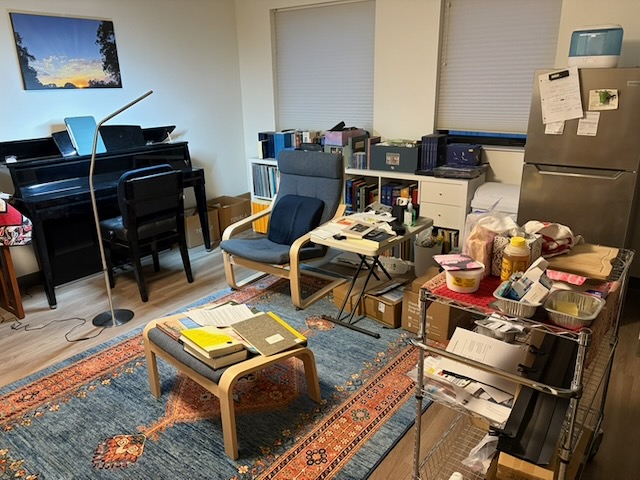
    After almost nine months of dedicated work, my apartment is finally messy enough to make it feel like home.

  • Degrees of separation: Paul Hindemith

    You know the concept of degrees of separation — that you can connect any two people in the world through a relatively small number of steps, in which A knows B, and B knows C, and C knows D …

    I amuse myself sometimes by playing this game to see who I can connect myself with. Case in point …

    I’ve just been asked to play the piano for a flute student who is working on the Flute Sonata by Paul Hindemith, an important 20th-century composer. I have a couple of connections to this piece, the first being that I’ve played it before, when I was at Connecticut College in the 1970s and 1980s, and played for a lot of flute students.

    But there’s an even closer connection, to the composer himself. In college, my piano teacher was Lydia Hoffmann-Behrendt. She knew Hindemith — they were both Germans who had fled from the Nazis and wound up in New England. Hindemith taught at Yale, so I assume he was more-or-less settled in New Haven. Mrs. Behrendt (as her students called her) had a studio in the music department at Dartmouth, 200 miles north of Yale, and was the de facto piano instructor, though I’m not sure whether she had any official appointment at the college.

    She certainly knew Hindemith well enough to have performed with him in New York in 1939, as this New York Times article demonstrates:

    https://www.nytimes.com/1939/04/24/archives/hindemith-offers-own-compositions-appears-as-violist-and-pianist.html

    So only two steps separate me from Hindemith.

    You can listen to the flute piece here: https://youtu.be/quDiUSgB8x0?list=RDquDiUSgB8x0