Buckle in. This is a long one.
Today, December 12, as I just discovered in my archives, is the anniversary of what is perhaps the most important milestone of my childhood. According to my transcript, I transferred into Lawrence (Mass.) High School on December 12, 1962. I guess there’s no better time to tell that tale.
We moved many times during my first seventeen years. Between the age of three and the time I went to college, I have memories of five communities in Maine, one in Massachusetts, and one in New Hampshire. It goes without saying that I got quite used to being uprooted. I was a stoic young soul, and it didn’t occur to me that this might not have been the natural order of things.
Demographic studies show that Americans were more mobile in the 1950s than they are today. Economic opportunities were expanding rapidly after World War II, and in any given year at that time, twenty per cent of the population relocated, though most of those moves (60-65%) were within the same county. I can’t prove it, but I strongly doubt that — except for corporate relocations and military transfers — many other families moved hundreds of miles every couple of years over a decade, as we did.
When we last saw me in this blog, I was sitting on a potato barrel in Limestone, Maine. If that photo dates from October 1962, as it probably does, there was a lot going on behind the scenes. My father, the town’s Methodist minister, was having an affair with one of his parishioners. Apparently I have suppressed most of the specific memories from this era, because apart from some furtive, whispered phone calls of my father’s, my recollection is just that there was an almost palpable atmosphere of simmering tension at home.
I turned fourteen around this time. I’m finding it hard to reconstruct what I was thinking and feeling, or how much I really understood of what was going on. I know I was confused about sex, and uneasy about the changes in my body that puberty had brought. I don’t remember being conscious of the gossip in town, or the scandal in the church, that (as is now obvious) were taking place around us. And I don’t remember anything about when and how we kids were told that we were moving, yet again, after barely a year and a half in town. This time we were leaving Maine altogether, and my father was being transferred to a new conference — i.e., a different geographic and administrative unit within the Methodist Church. Does this remind you of the Catholic Church’s habit of shuffling abusive priests around rather than confronting the problem? Me too.
I have pretty vivid memories of the move itself — though research on memory has shown that a lot of what we think we remember is actually a story we make up to fit the mental picture we have of the time in question. But even if some of these memories are embellished, what’s important is that this is the way I remember it.
We were essentially run out of town on a rail. That language may seem overblown, but remember that this was a clergyman leaving town with his young family in mid-December while school was in session. What was the hurry? They couldn’t have waited for school break? They couldn’t have waited for Christmas?
My memory of the drive to Lawrence is that it took place in the dark. Given that the distance was 350 miles, that I-95 had not yet been built, and that these were the shortest days of the year, most of it surely did take place in the dark. My memory of arrival is this: we four kids being awakened in the car in the middle of the night with “We’re here”, and stumbling into our new parsonage without a chance to get a good look at it.
I had entered Limestone High School as a freshman the year before; I was now a couple of months into my sophomore year. In the early 1960s, Limestone had a much better high school than its beyond-the-end-of-the-earth location would suggest, because in the previous decade the US Air Force had built Loring Air Force Base just outside of town. The population within the town’s boundaries had increased from 2,427 in the 1950 census to 13,102 in 1960 — all of it due to the presence of the base.
Loring was a major, if not *the* major, unit in the Strategic Air Command. The Air Force chose Limestone because it was at the farthest northeastern point in the continental United States, and thus closest in air miles to western Europe. (You could go farther north in Maine, but you had to turn west to do so; the Canadian border turned west just north of Limestone.) This was the height of the Cold War, and the mission of the Strategic Air Command was to keep armed bombers in the air 24 hours a day just outside of critical range of Russia, in case the Russians struck first. Watch the movies Fail Safe and Dr. Strangelove to get some idea of the times.
Loring AFB had its own elementary schools, but there weren’t enough children of high school age on the base to warrant building a high school there. Instead, the base sent its high-schoolers to Limestone High — which meant that there was Air Force money pouring in, and more than just farm kids went to school there. The town had just built a new high school with that money. In any case, this was post-Sputnik, and the country was in the mood to invest in education. I took Latin as a freshman, and both Latin and French as a sophomore. I started cello lessons on a school cello and participated in all-county orchestra. I was in a school play (The Curious Savage, by John Patrick, if anyone cares.) I wasn’t athletic, but I was getting by in gym, and the gym teacher wasn’t a monster. There was every indication that I might be starting to fit in.
And then, suddenly, I found myself in Lawrence, a decaying mill town in northeastern Masschusetts, just far enough from Boston that Boston was inaccessible to a 14-year-old — or at least to this 14-year-old. Lawrence had had its heyday in the first decades of the 20th century when the mills were running at capacity. By 1960 the mills had moved to the South where labor was cheaper, and Lawrence’s population had dropped from 94,270 (1920 census) to 70,933 (1960 census). Lawrence has never recovered economically. Although its population is almost back to 1920 levels, it remains one of the poorest communities in the state. Its city government is notorious for its corruption (and in Massachusetts this is saying something); its schools are so bad that the entire school system was recently taken over by the state.
I don’t think things were quite as bad in 1963 as they are now — they’ve had sixty years in which to get worse — but the culture shock of being embedded in rural Limestone, Maine, one day, and in multi-ethnic, urban, decaying Lawrence, Massachusetts, literally on the following day, was almost overwhelming.
(Digression: I share with Robert Frost the distinction of childhood residency in Lawrence. Frost, born in San Francisco in 1874, arrived in Lawrence in 1885 after the death of his father and “under the patronage” (as Wikipedia puts it) of his grandfather, who was a supervisor at one of the Lawrence mills. Frost graduated from Lawrence High School in 1892 as co-valedictorian with his soon-to-be wife, whom he married in Lawrence in 1895. (Despite his reputation as a poet of the land, he grew up a city boy.) By 1900 he had dropped out of both Dartmouth and Harvard and was farming in Derry, NH — another town I have a connection with, since my sister Janet lived there for a fairly long time.)
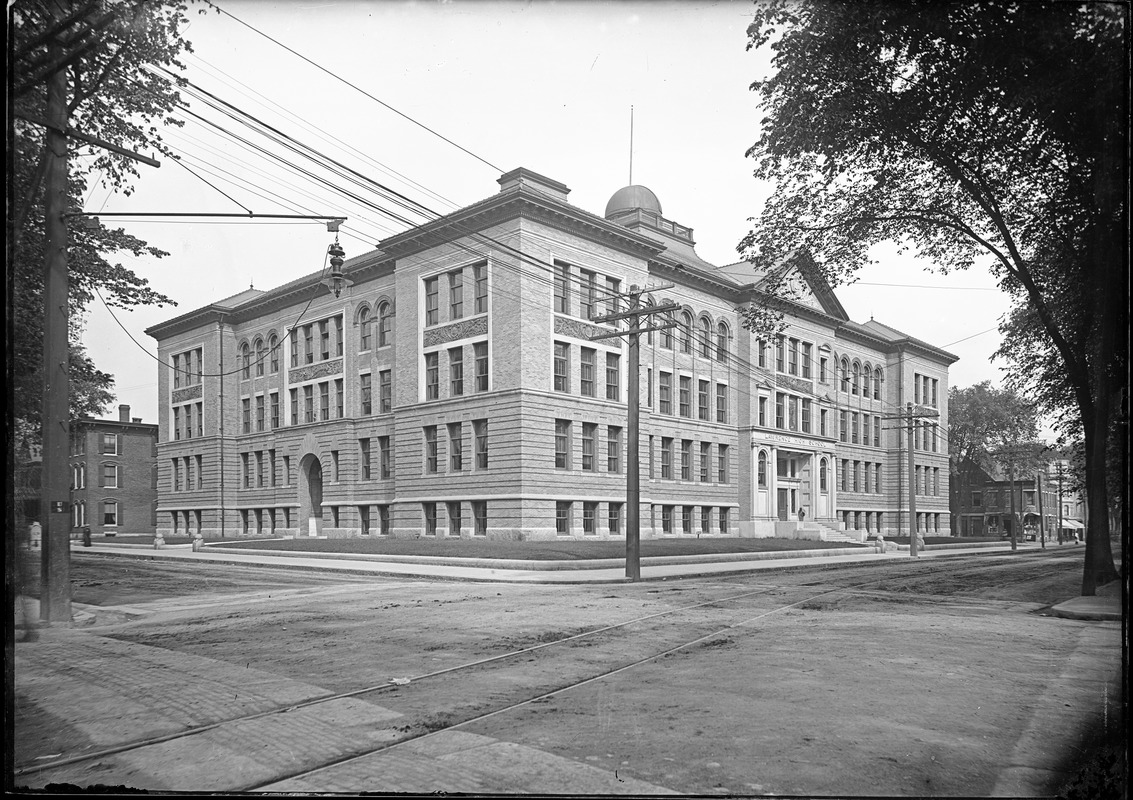
The high school Frost attended had been demolished long before I got to Lawrence. In 1899, around the time Frost left Lawrence, the city had broken ground for an impressive new high school in a somewhat bastardized Richardson Romanesque style. Twenty-five years later the city expanded it with a large annex. By the time I enrolled at Lawrence High, the massive, forbidding structure occupied an entire city block.
Looking back, it seems as if I was almost, but not quite, thrown to the wolves at Lawrence High. What actually happened seems now so bizarre that I’ve never been able to explain it. It’s almost enough to convince me that a guardian angel was watching over me.
I don’t know how much time elapsed between our arrival in Lawrence in the middle of the night and the day I was to start school at Lawrence High. There must have been at least a day or two intervening. The calendar says my first day at Lawrence High (December 12, 1963) was a Wednesday. I’m going to guess that we traveled to Lawrence on the previous weekend, although that *is* just a guess. The day before I was to start school, a boy showed up at our door, introduced himself as Chuck Feeney, said he was an upperclassman at Lawrence High who lived a few doors up the side street from us, and offered to walk me to school. I may have been to Lawrence High to register, but I don’t remember doing so. I didn’t know the way, there was no school bus, and there had been no talk of my being driven to school, so the apparition of Chuck at our door was something of a godsend.
There must be a mundane explanation for Chuck, but I don’t know what it is. My parents were apparently not behind it; they seemed as surprised as I was. It’s very unlikely that anyone at my father’s church instigated it; Chuck had no connection with the church. In fact, the church (like just about everything else in Lawrence) was ethnic, but it was German. There were no Feeneys in the congregation; the names I remember are Hildebrand, Kress, and Dimmlich. I never asked Chuck about his family background, but he volunteered that he lived with his Lithuanian grandmother, who spoke no English. (That’s Lawrence in a microcosm.)
I don’t know for how many days or weeks Chuck walked me to school. It’s possible that we walked to school together for the entire six months that I remained at Lawrence High. However long or short our association, I remember him with gratitude as a mentor. He taught me my first swear words, and his favorite adjective of approbation was “sexy”.
I felt safe with Chuck, but once I got to school, the situation was different. Without a protector and mentor, I now for the first time resented and dreaded school. The building resembled a prison more than it did a school (at least to me). In my memory the corridors are cavernous; the teachers are grim; the atmosphere breathes unease. It’s like something out of Poe. The building looked as it had in 1924, and the curriculum, the furniture, the textbooks, and (seemingly) even the faculty had all mummified around the same date. As far as I can remember, the French book literally offered “Où est la plume de ma tante?” as an example of a conversation starter. Catcher in the Rye had been published over a decade earlier, but the English Department’s idea of a contemporary novel that would appeal to teens was Booth Tarkington’s Seventeen. Gym had been no fun at Limestone, but bearable; at Lawrence High I heard my first “Are you queer?” During breaks we were allowed (“herded” is the better word) into the park across the street, where I spent the entire time trying to stay clear of the toughs who were looking for somebody to beat up, or at least to harass verbally. The cello had stayed behind in Maine because it belonged to the Limestone school system. If music or theater existed at Lawrence High, they remained concealed to me.
After a few months I was in such pain that I told my parents “I’m not going back there.” At least that’s apparently what I said. I have no memory of that, but then a lot of that time period is hazy now. I can hardly believe that I found that level of assertiveness. If alternative schools existed in 1963, my parents didn’t know about them. Prep school was what occurred to them. Phillips Andover Academy (Andover was next door to Lawrence) was their solution of choice for me, but it didn’t happen. The only thing I remember from the interview at Andover was that I was advised to develop an interest in sports; if I did, they might possibly consider me.
I’m sure my parents were floundering at this point. I feel sorry for them now. I realize that they were trying to do their best, but they had never known what do with me. What they came up with next must have been virtually unthinkable: a Catholic school. They got me into Lawrence’s Central Catholic High School — and on reflection they and I could have done worse. At least I felt safe there. I don’t know what it cost, but it was probably relatively cheap, and the academics were likely about as good as anywhere else short of Boston Latin. Central Catholic saved me from what might have been complete disaster. Eventually, like Robert Frost, I was valedictorian at a Lawrence high school — just not the same high school as his. But that is a story for another post.
 Phil’s Blog